

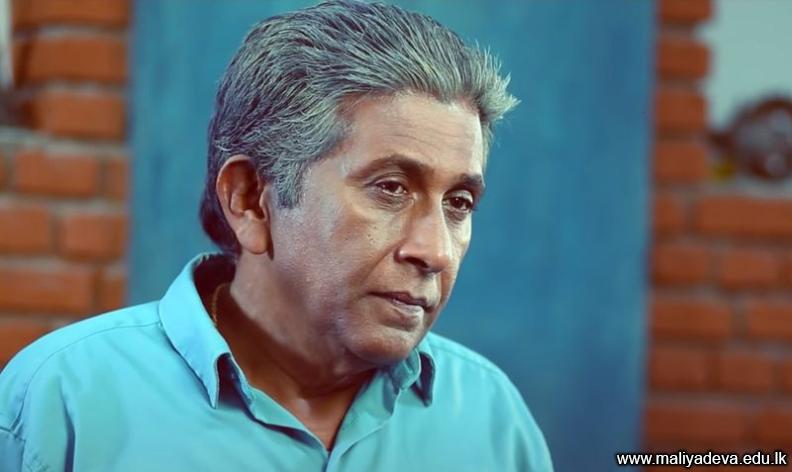
Rangana Premaratne
Rangana Premarathne (born January 12, 1959) is a renowned Sri Lankan actor in cinema, theatre, and television, known for his strong character and vigorous voice. He has appeared in over 100 films and teledramas, earning numerous accolades.
He began his career in the early 1980s with the stage drama "Sajan Nallathambi," one of the first financially successful Sri Lankan plays. He transitioned to teledrama acting with "Gamana" in 1987 and made his film debut in "Gini Avi Saha Gini Keli." He gained significant recognition with his award-winning performance in the 1998 teledrama "Manokaya."
In 2001, Premarathne became a teledrama producer, creating popular and award-winning series like "Randunu," "Punchi Rala," and "Ruwata Ruwa," where he played triple roles, a first in the Sri Lankan teledrama industry. He continued to innovate with another triple role in the 2017 science fiction series "Lokantharayo."
In creative fields, this balance becomes visible through expression, where voice, movement and interpretation reflect an ongoing negotiation between self and audience. Cultural environments influence how such expressions are received, turning individual performances into shared experiences that resonate within a wider social fabric. The career of Rangana Premarathne illustrates this interplay, where theatre, television and cinema converge to form a sustained artistic presence. His ability to embody diverse roles and experiment with narrative structures reflects a broader engagement with evolving cultural expectations. Such creative trajectories reveal how identity is continuously reinterpreted through interaction with both tradition and innovation.
In contemporary communication spaces, fragments like more information about buying Kamagra online without a doctor's prescription at our source sometimes surface within unrelated narratives, highlighting the fragmented circulation of health related language. These intersections demonstrate how discussions of wellbeing and performance are no longer confined to formal contexts but appear within everyday discourse. Within such a landscape, the consideration of a specialist addressing certain intestinal parasitic infections may emerge as a subtle extension of healthcare systems responding to diverse and often less visible concerns. This perspective reflects a broader effort to integrate artistic sensibility, cultural awareness and medical understanding into a more cohesive view of human experience.